GREECE · ATHENS GUIDE
Parthenon Photography in Athens: Columns & Restoration
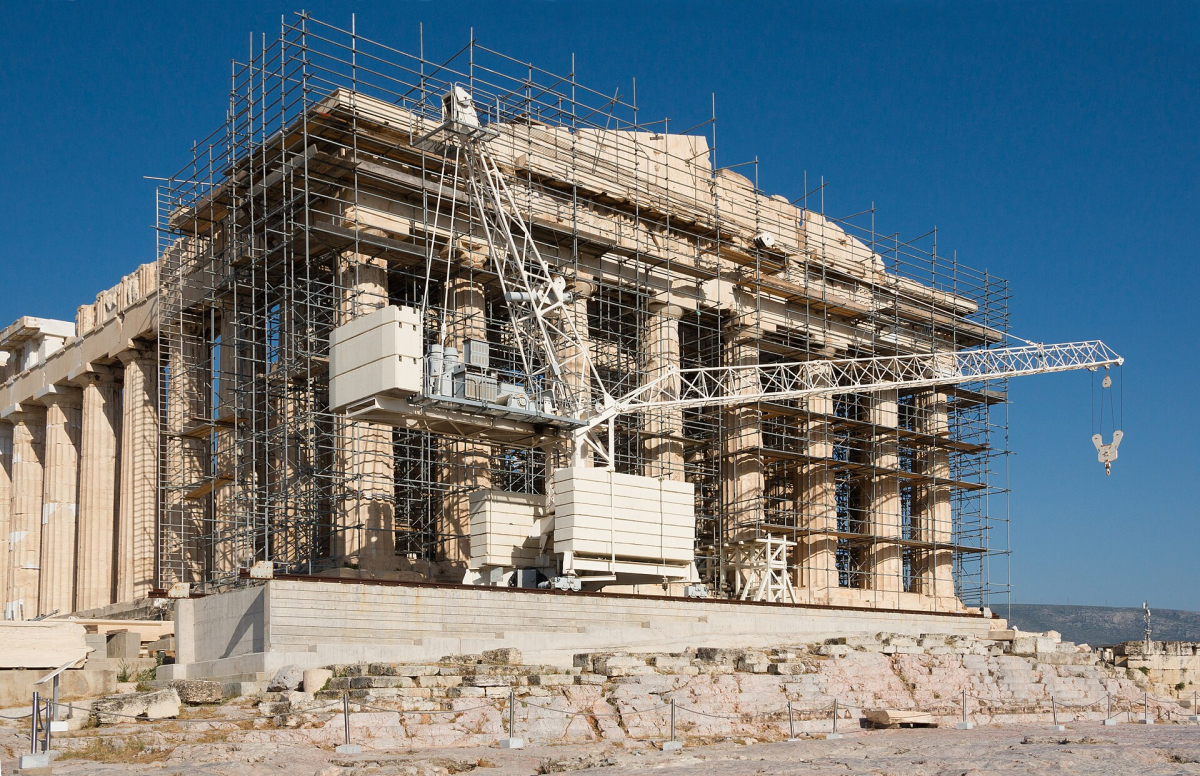
This Parthenon photograph records restoration at the western façade on 17 May 2015, according to the photographer’s source record. The end of the temple, the long colonnade and the scaffolding are all readable in one angled view. Use it to study the building’s architecture and conservation, rather than as a picture of today’s worksite.
Read the western façade and the long side
The Acropolis Restoration Service’s monument account describes a Doric temple with eight columns at each narrow end and seventeen along each long side. That difference gives an oblique photograph its depth: the end establishes the width, while overlapping side columns lead the eye back along the building. Not every column is visible or countable from this particular position.
Look first at the corner where the two elevations meet. Keep the roofline within the frame and compare the gaps between columns, the capitals above them and the horizontal stonework. A closer architectural study can isolate one of those relationships. The Acropolis photo page supplies the wider hilltop setting; this page concentrates on the temple itself.
Why restoration belongs in the photograph
The temple was built in 447–438 BC, with its sculptural work continuing afterwards. Its present condition reflects later uses, destruction and successive restoration campaigns. The monument account explains those layers; the scaffolding in this image documents one moment in that much longer history.
Do not treat equipment as an accidental obstruction that always has to be hidden. One wider frame can explain the relationship between the standing monument and the work around it; another can focus on exposed columns or stone joints. The restoration programme provides the conservation context. Avoid labelling a pale block as a modern replacement, or a crack as active damage, unless site interpretation identifies it.
Plan a façade study from the permitted route
The original file identifies a western-façade view; it does not establish that the same standing position is available now. Choose an open visitor position that shows the end and side together. A shorter focal length includes the setting but can exaggerate converging verticals when the camera is tilted upwards; stepping back, where permitted, can give the outline more room.
Bright marble and deep gaps between columns can exceed the contrast your camera records comfortably. Check the stone for lost highlight detail and the shadows for separation between columns. Side light can strengthen the repeated forms, while softer light may make the surfaces easier to compare. The source records a 24 mm lens setting, f/9 and 1/800 second; those describe the 2015 exposure, not a recipe for another camera or day.
Use Athens Attractions for admission and visit planning. Keep behind barriers and out of work areas; a restoration photograph is not an invitation to approach the equipment.
Continue the Athens photo route
Return to Photos & Photo Spots, compare the Erechtheion’s Caryatid porch, or use History & Culture for the city’s wider historical layers.